- Works well when
- Unclear who's got the ball and what should be happening
- There is something important but no one feels like it's their responsibility
- Solving complex cross-functional issue
- John Allspaw - How Your Systems Keep Running Day After Day
- People have "mental models" how the system works
- They operate "above the line"
- Nobody can see "the code running" (below the line)
- Models are incomplete
- They operate "above the line"
- Incidents are unplanned Investments in company survival
- Burn money, time, reputation, staff
- How do you maximize ROI? Learn!
- Incidents provide calibration
- decision, attention, coordination, escalation
- An incident can be "company" destroying moment (Equifax)
- At the beginning we don't know
- All incidents can be worse
- What went well? How did we stop it from escalating further?
- Important to make sure we don't "remove" that accidentally
- What went well? How did we stop it from escalating further?
- Company that can learn from the has competitive advantage
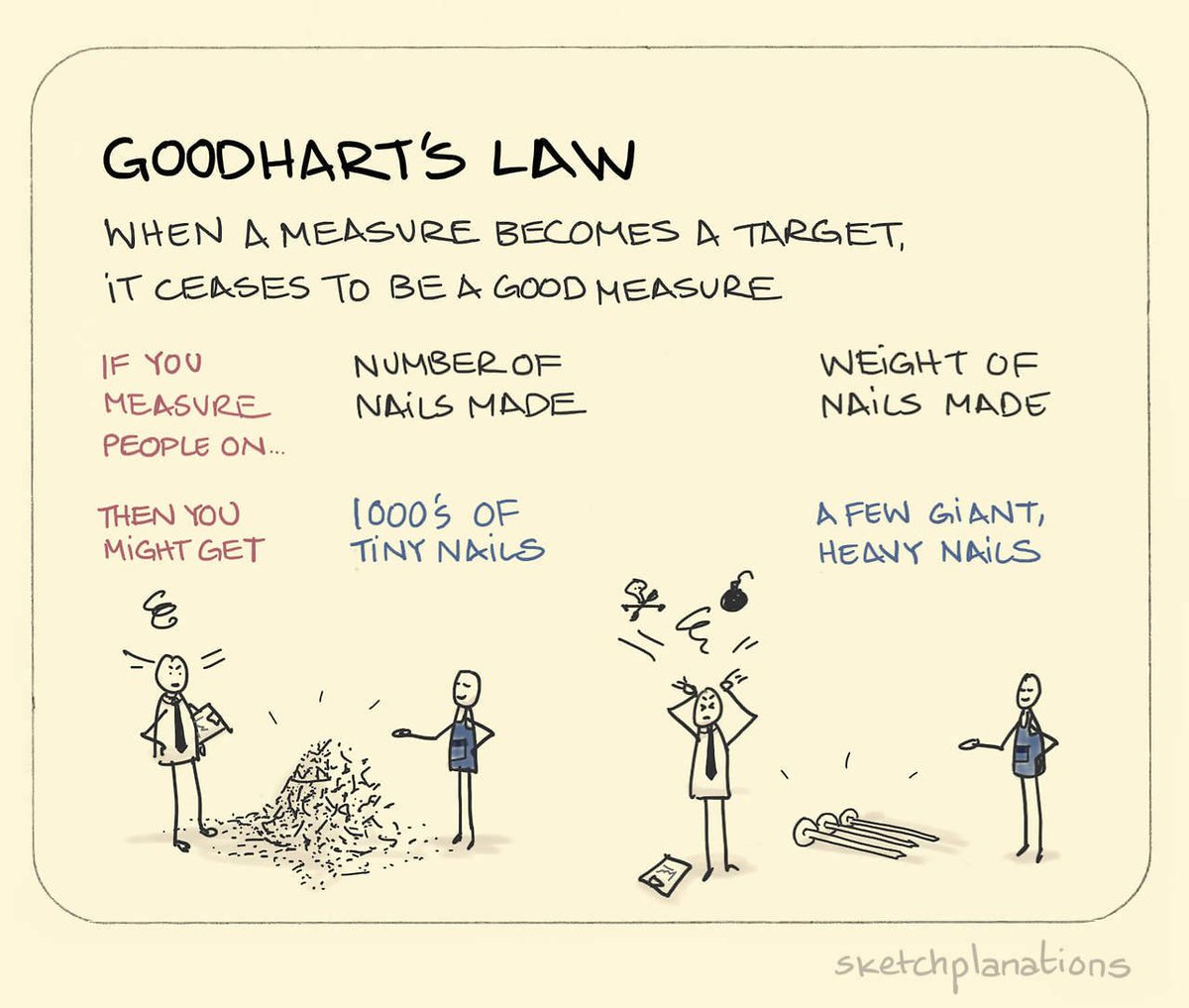
- Goodheart's Law
- "When a measure becomes a target it ceases to be a good measure"
- Number of nails: 1000's of tiny nails
- Weight of nails: a few giant heavy nails
- "When a measure becomes a target it ceases to be a good measure"
- "Taking the high road has never once come back to bite me in the ass."
- Amygdala - hijacking
- SCARF (threats that triggers us)
- Status - sense of self-worth
- Certainty - familiar situations require less energy to process. Lack of clarity increases stress
- Autonomy - giving autonomy gives a reward response
- Relatedness - sense of belonging with others
- Fairness - if something is unfair brain goes into defense mode
- See also: http://it.toolbox.com/blogs/mainframe-world/managing-people-the-scarf-model-65668
- optimize for long-term work relationships (even if you change jobs)
- be a light bulb that lights up dark places
- even the strongest bridge needs flexibility to stay strong
- Disagreement
- from 1 to 10: how much do I care (see override bar)
- first one to draw a visual wins
- Transparency in communication
- core message
- how recipient may be feeling
- my own understanding
- in leadership don't worry so much about career direction
Video: Roy Rapoport (Culture and the games)
- Financial motivations backfire easily
- Define what behavior you want (e.g. innovation, availability, collaboration)
- Build the "rules" that don't contradict this goal, e.g.
- Avoid zero-sum games
- Stack ranking
- Wrong financial incentives
- Avoid zero-sum games
- Build the "rules" that don't contradict this goal, e.g.
- Override bar
- How certain I am that I'm right?
- What is the cost if someone does it his way?
- Is it really worth forcing your mind?
- Implementers - execute other's ideas
- Problem Solver - given general description & left to its own devices
- Problem Finder - total autonomy. Your task is to figure out the problem!
- Asking for permission moves responsibility onto manager
- You should tell me what you want to do and we will discuss risks and alternatives
- Based on "Turn the ship around" book
- Being manager is a career change
- Mental model shift: tie your individual success to team success
- Teal is based on
- Goal (non-financial) shared by others
- Wholeness - you are in the company along with all your emotions
- Examples
- Zappos
- Patagonia
- Taking notes
- Helps remember and organize thoughts (filtering + preprocessing)
- Signals commitment
- Be deliberately redundant (overcommunicate)
- Google Docs - shared screen
- Block 15 minutes after meeting to note
- Paraphrase what was said
- Praise must be specific
- Absence of praise is felt
- It helps coontinue the right behaviiour
- Balance "Challenge" (difficulty) of the task with employee "Skill"
- Try to keep in the "Flow" zone
- If tasks are varied - do it per group of tasks
- Bad extremes: boredom, anxiety, apathy
- Product Manager
- Empathy
- Communication Skills
- Business Sense
- Cloning yourself is not an option
- Use force multiplier
- Lack of employee onboarding incurs team debt
- "Senior" is very ambigous
- 2 years of experience in new framework
- 20 years of experience
- "Culture fit" is used to hide biases
- Cojoined trinagles (Direction Provided vs Required) is nice but oversimplified
- Senior can be measured on 3 dimensions
- Technical Ability
- Leadership
- Find&Fix broken things
- Persuasion
- Connectedness
- Part of larger whole
- Desire to contribute
- Skill is not an On/Off - it is a continuum. It may change overnight
- Title may be too rigid. My title says X so I should not be doing Y
- Generic Software Engineer
- Very difficult to evaluate who is at what level
- Better talk about "mature" than "senior"
- They know, nothing they do is perfect. Upon completing project:
- What am I missing?
- How will this NOT work?
- Can you shoot holes in my thinking?
- Is it easy to troubleshoot, operate, extend?
No comments:
Post a Comment